Research
LaSAI research on multilingual, interpretable, and human-centered language intelligence.
Language Science for AI & AI for Language Science
LaSAI treats language science and artificial intelligence as a two-way exchange. Linguistic and cognitive insights help us understand and improve AI systems; AI models and computational methods give language researchers new instruments for studying language, culture, and cognition.
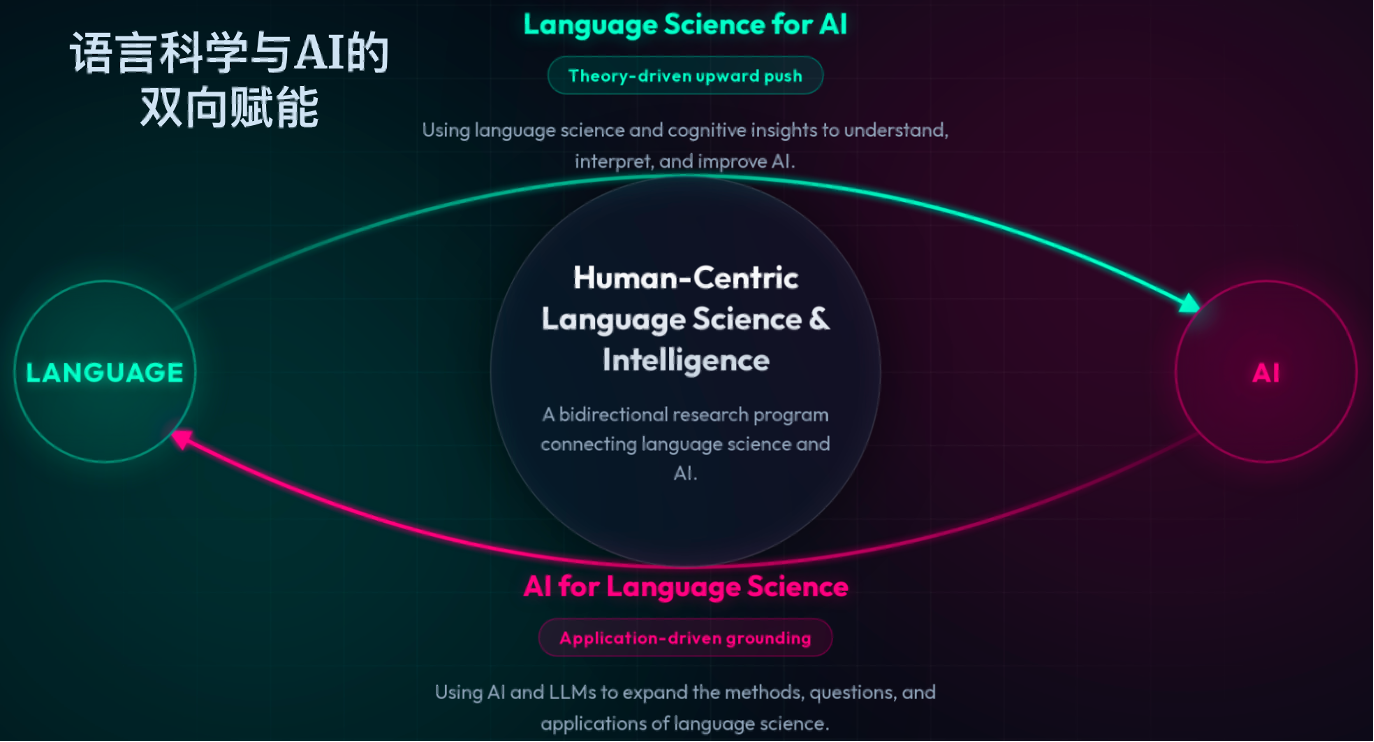
Language Science for AI
We use linguistic knowledge, multilingual evidence, and human language-processing research to explain how language models work, diagnose cross-lingual and cross-cultural failures, and design evaluations that better reflect human language behavior.
- Mechanistic interpretability of multilingual LLMs
- Cross-lingual knowledge, transfer, and language confusion
- Human-inspired evaluation and model design
AI for Language Science
We use language models and computational methods as research instruments for linguistics, cognition, historical language research, digital humanities, and neighboring human and social sciences.
- Computational models of language and cognition
- Low-resource and historical language technologies
- AI-assisted research in the humanities and social sciences
🧠 主要研究方向
研究组目前重点围绕 “多语言 × 可解释性” 开展两条研究主线:
大模型多语言跨文化感知的机制解释与评测
研究大语言模型如何获取、表示、编辑、检索和使用不同语言中的语言知识与事实知识,并解释语言混淆、跨语言不一致和跨文化偏差等现象。
人类语言认知加工与大模型机制可解释性的对比研究
将心理语言学、神经语言学和认知科学中的实验范式与模型内部表征分析相结合,比较人类与大模型在形式、意义、知识和推理过程中的异同。
Research themes
Multilingual & Cross-cultural AI
Cross-lingual transfer, multilingual representations, knowledge consistency, low-resource languages, and culturally grounded evaluation.
Interpretability & Internal Mechanisms
Mechanistic interpretability, language confusion, knowledge editing, model behavior, and representations of language and reasoning.
Language, Cognition & the Brain
Human-inspired NLP, neurolinguistic probing, conceptual representation, and comparisons between human and machine language processing.
AI for Language & Humanities
Computational approaches to historical language, digital humanities, education, culture, and interdisciplinary human-centered research.
Efficient & Agentic NLP
Prompt- and retrieval-based learning, memory-augmented agents, low-resource learning, parameter-efficient adaptation, and model efficiency.